
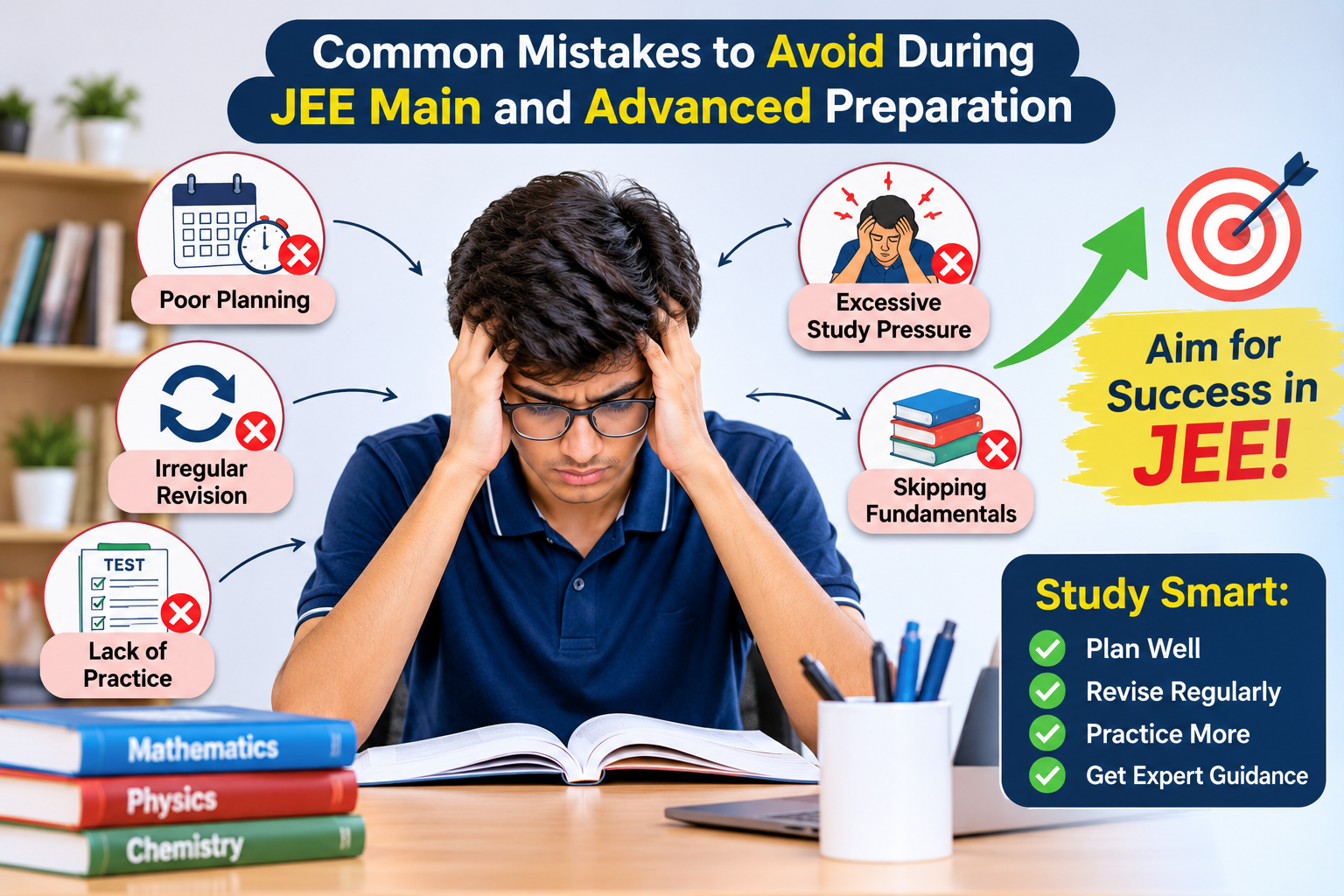
Getting ready for the Joint Entrance Examination is not about toiling away long hours in the physics, chemistry and mathematics books. Students must have a clear approach to preparation and consistent practice, time management, and conceptual knowledge. But there are some avoidable minor mistakes that occur in competitive exams by many of the aspirants, which impair their ability to perform well in the exams. A good JEE Academy in Chennai will offer guidance, but students should also get proper study skills to make their preparation effective. By recognising these common errors early on, aspirants can adapt their approach to learning, reduce any unnecessary pressure, and strive towards fulfilling their engineering admission dreams.
Let’s dive into this blog to explore the common mistakes students should avoid during JEE Main and Advanced preparation and discover practical ways to make their preparation more effective.
Every wrong answer holds a lesson that can lead you towards the right future.
1. Studying Without a Proper Preparation Plan
One of the most common mistakes among JEE aspirants is beginning their preparation without a clear timetable or study plan. Students often spend too much time on their favourite subjects while ignoring topics they find difficult. This creates an imbalance in preparation and makes it challenging to complete the syllabus on time. A practical study plan should cover all three subjects, including Physics, Chemistry, and Mathematics. Instead of randomly selecting chapters, students should organise topics based on their difficulty level, importance, and understanding.
A practical study plan should cover all three subjects, including Physics, Chemistry, and Mathematics. Instead of randomly selecting chapters, students should organise topics based on their difficulty level, importance, and understanding. A realistic timetable helps students maintain consistency without feeling overwhelmed. It is also important to review the schedule regularly and make changes whenever necessary.
Consider these points while preparing a study schedule:
- Divide the complete JEE syllabus into smaller, manageable topics.
- Allocate sufficient study hours to each subject.
- Set weekly targets instead of planning everything for a single day.
- Include revision sessions and mock tests in the timetable.
- Keep additional time for chapters that require more practice.
2. Ignoring Basic Concepts and Focusing Only on Difficult Problems
Most of the students think that if they get the answers of advance level questions then they will get the answer to improve their marks in JEE examination. Consequently, they then begin to work out problems without learning the basics. Such a method can often cause confusion, particularly where more than one concept is used in a set question. Good bases make things easier to grasp more difficult concepts and how to apply concepts properly in the exam. A student who has not coped well with the fundamentals of physics mechanics shouldn’t be able to solve higher-level problems of motion, force and energy generation. In the same way, knowing fundamental chemical reactions is important before you proceed to the complex questions on organic chemistry.
Students ought to learn to do so progressively:
1. Understand the basic concepts of each chapter.
2. Learn important formulas, definitions, and principles.
3. Solve simple questions to strengthen understanding.
4. Progress to other moderate-level problems.
5. Practise advanced questions after gaining confidence.
3. Depending Only on NCERT or Too Many Reference Books
Selecting the proper study materials is another crucial aspect of JEE preparation. Some pupils use just one book, while others have a number of reference books, coaching materials and Internet links. Both strategies can cause issues if students are not applying the strategies correctly. In comparisons with other subjects, NCERT Books for Chemistry is of prime importance, as it gives a firm base to fundamentals. But there is ample practice to solve the problems with conceptual application, which is a must in JEE Main and Advanced too. Students should limit the number of resources they choose to compile, and be thorough in their work of compiling good, reliable resources. Going back to old sources can be more effective than continually changing sources.
| Study Material | Purpose |
| NCERT Textbooks | Understanding fundamental concepts |
| Coaching Modules | Chapter-wise practice and structured learning |
| Previous Year Papers | Understanding question patterns |
| Reference Books | Additional conceptual and problem-solving practice |
| Mock Tests | Improving exam readiness and time management |
Also Read This: What to Look for in a NEET Coaching Centre Before You Enrol
4. Avoiding Mock Tests and Previous Year Question Papers
Concepts are always important, but students need to be able to apply their knowledge in an exam situation. One of the most common disaster measuring deceptive marks is failing to take the mock tests, as this does not reflect their real preparation. Students with mock examinations have an idea of what it’s like to solve a question within a certain time frame. They also offer helpful feedback on accuracy, speed and question selection. Students should review their score, but should also look at their work after every mock test to analyse their performance. The reasons for an incorrect response is more useful than lists of the correct answer.
Regularly practising JEE Main and JEE Advanced previous year question papers can help students:
- Understand the examination structure and question formats.
- Identify frequently tested concepts and topics.
- Improve speed while solving numerical problems.
- Recognise weak areas that require additional attention.
- Develop confidence before the actual examination.
5. Poor Time Management During Preparation and Exams
Managing time is an important factor in preparation for competitive exams. Some students invest hours of their time into a problem-type question, which leaves them with a limited time period for other questions and even important chapters. This habit can affect both preparation efficiency and examination performance. Students should be taught about the process of solving a question and the time to move on.
Enhancing their time management skills can be accomplished with the following strategies:
During daily preparation:
- Use a set time schedule and allow brief breaks.
- Focus on key and challenging chapters.
- Don’t go on too long on a given subject.
- Maintain separate revision and practice sessions.
During examinations:
- Read questions carefully before attempting them.
- Use questions that you know you can answer the first time.
- Do not do too much work on a lengthy calculation.
- Keep time for reviewing answers whenever possible.
6. Neglecting Revision and Forgetting Previously Studied Topics
Just finishing the JEE syllabus does not imply that students have got prepared for the exam. If it is not revised periodically, formulas, reactions, definitions, and problem-solving techniques and methods become hard to remember. Many candidates put in lots of hard work learning the latest chapters, and don’t begin revision until towards the end of the month. This can cause needless stress and make it much more difficult to remember what has been learnt previously. Students can also maintain a separate formula notebook for Physics and Mathematics and a reaction or concept notebook for Chemistry. These notes eliminate the need to revise at the last minute; they are an organised and time-saving revision option.
An effective revision method should include:
Daily Revision: Spend 15–30 minutes reviewing concepts studied during the day.
Weekly Revision: Revisit important formulas, reactions, and challenging questions from completed chapters.
Monthly Revision: Solve chapter-wise tests covering previously studied topics.
Final Revision: Learn the short notes, important concepts, corrected and regularly practised questions.
7. Not Analysing Mistakes and Repeating the Same Errors
It’s normal to make mistakes in preparation. Failing to correct the same issues over and over again, however, without knowing how and why they happened in the first place can impede progress and improvement. Some students look at their mock test results but do not analyse problems. Others at once see ways around the problem and don’t try to reach the answer. Write down hard questions, analyse why each one is wrong and do them again later, say after a couple of days. This simple habit can have a great effect on accuracy and conceptual grasp. A better approach is to maintain a mistake-tracking notebook.
Divide mistakes into three categories:
1. Conceptual Mistakes: Occur when the student does not understand the underlying concept.
2. Calculation Mistakes: Happen due to incorrect calculations, formula substitutions, or unit conversions.
3. Question Interpretation Mistakes: Occur when students misunderstand what the question is asking.
8. Ignoring Physical Health and Taking Unnecessary Study Pressure
It can be stressful to prepare for JEE, especially if preparing for school exams, coaching, assignments, and self-study. But constantly studying and learning without getting proper rest will impact concentration, memory, and productivity as a whole. Many students sleep little to read more chapters. Others break their achievements down and worry unnecessarily about their preparations in comparison with their peers.
Here are some habits that it may be worth practising:
- Ensure adequate rest to aid in focus and memory.
- Make use of short breaks within long study periods.
- Include physical activity or walking in your daily routine.
- Consume well-balanced foods and plenty of fluids.
- Don’t spend too long watching TV or digital screens for fun.
- Discuss academic difficulties with teachers or mentors instead of keeping them to yourself.
Your biggest competition in JEE is not another student, but the mistakes you haven’t corrected yet.
As well as preparing extensively for competitive exams, students also need to prepare strategically for success. Learning can be more productive if students avoid common mistakes like improper planning, irregular revision, lack of sufficient practice, and excessive study pressure. Choosing the right JEE Academy in Chennai can help students develop strong fundamentals, follow structured learning methods, and receive proper academic guidance. Pupils should develop good basic skills, take regular tests, and review their performance to improve. With dedication, the right study material, and proper guidance from experienced teachers, aspirants can approach JEE Main and Advanced with a better mindset and achieve their engineering admission goals.